 Dogs Explained
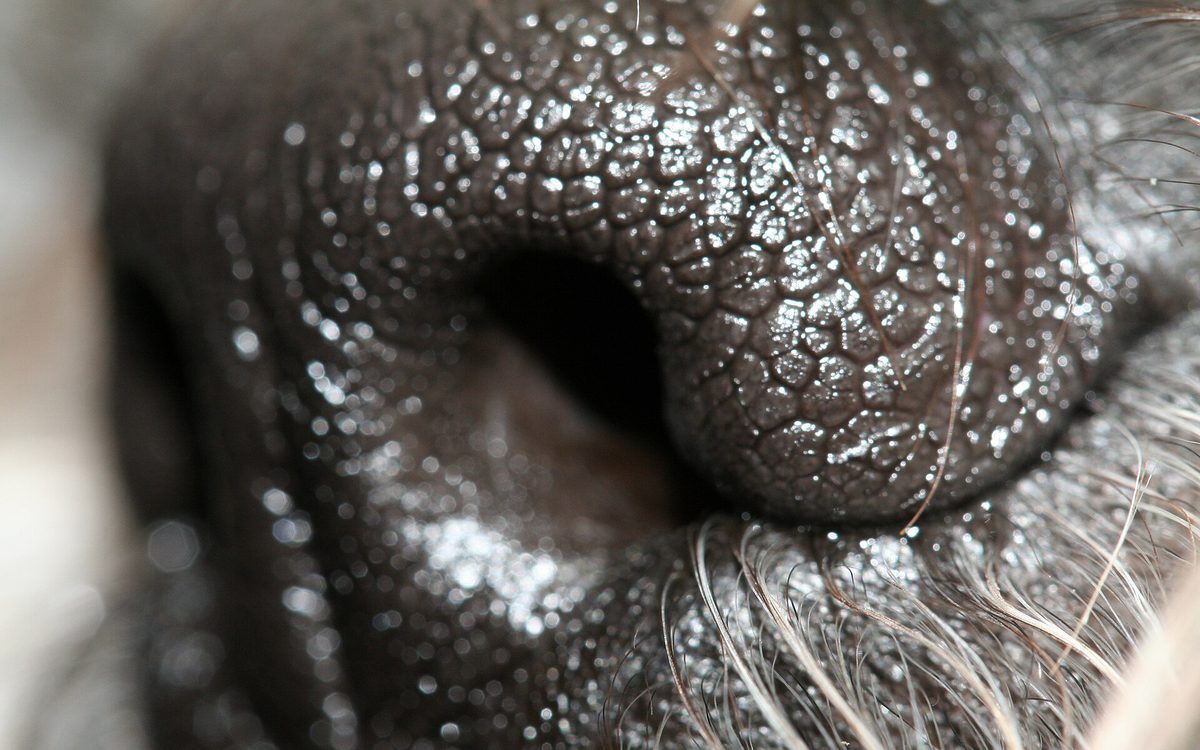
A dog's nose smells so much better than ours for three reasons: it has far more scent receptors, it sends air down a separate smelling path, and a large part of the dog's brain is devoted to decoding odour. A dog can have up to about 300 million scent receptors, while a human has about 6 million.
The result is that a simple sniff gives your dog a rich, detailed report about the world. Here is how each part of the system works.
How many more scent receptors does a dog have?
Scent receptors are the tiny sensors that catch odour molecules and turn them into signals the brain can read. Dogs have up to about 300 million of them. Humans have about 6 million.
The words "up to" matter here. The number varies between breeds, so the figure describes the top end rather than every dog. Even so, the gap between dogs and people is huge.
More receptors means a dog can catch more odour molecules from the same breath of air. It also means they can pick up scents that are too faint for us to notice at all.
Why can a dog breathe and smell at the same time?
In humans, breathing and smelling share the same airflow. The air we use to smell is the air heading to our lungs.
A dog's nose works differently. Inside the nose, a fold of tissue splits the incoming air. Some of it goes on to the lungs. The rest goes to a dedicated smelling area, called the olfactory region, where odour can collect.
This gives dogs a separate path for smelling. Scent has time to gather in the right place instead of being swept straight past it with every breath.
What actually happens when a dog sniffs?
A sniff is more than a quick breath in. Here is the journey of a scent, step by step:
- Air carries odour molecules into the nose. The moist surface of the nose and nasal passages helps trap them.
- A fold of tissue splits the air. Part goes to the lungs and part goes to the smelling area.
- Receptors catch the molecules. Each receptor responds to particular kinds of odour.
- Signals travel to the brain. A large share of the dog's brain is devoted to processing smell, much more than in humans.
- The brain decodes the pattern. This is how a dog works out what a smell is and what it might mean.
There is one more clever detail. Dogs breathe out through the slits at the sides of their nostrils. Watch a dog sniff closely and you may notice this. Because the used air leaves sideways, fresh scent keeps flowing in from the front.
This is part of why a sniffing dog can keep sampling the air without the outgoing breath pushing the scent away.
Can a dog tell which direction a smell is coming from?
Possibly, and the nostrils may play a part. Airflow imaging suggests that each nostril draws air from a separate region in front of the nose. That could let a dog compare the odour on the left with the odour on the right.
This idea is called "stereo smelling". It has been shown experimentally in rats and in humans. For dogs, the direct proof is limited, so it is best described as something that may help them find the direction of a smell.
If you have ever seen your dog swing their head from side to side while following a scent, this is the kind of thing researchers think could be going on. It is a reasonable idea, but not a settled fact.
Why is a dog's nose wet, and is there a second smelling organ?
The moisture on a dog's nose helps trap scent molecules. Mucus on the nose and in the nasal passages catches odour, which makes it easier for the receptors to detect.
A dog's nose can naturally look wetter or drier at different times of day. A slightly dry nose on its own is not a reason to worry. If you notice ongoing changes, such as discharge, bleeding, crusting, or your dog seeming unwell, it is best to see a vet.
Dogs also have a second smelling organ, called the vomeronasal organ or Jacobson's organ. It detects chemical signals, such as pheromones, from other animals.
This is a different job from ordinary smelling. It adds another layer of information about who has been nearby.
Why are Bloodhounds so good at following a trail?
Bloodhounds belong to the scent hound group. They are famous for following scent trails, including over long distances. The breed has a long history in scent tracking and search work.
The basic nose design is shared by dogs in general. Scent hounds are simply known for putting it to work with great focus and determination.
This also explains something every owner has seen. When a dog stops dead on a walk and will not move, they are not being stubborn for the sake of it. They are reading something.
What does this mean for walks and play?
Sniffing is not a bad habit to be stopped. It is how your dog takes in information, and it is a natural and satisfying activity for them.
A few kind, reward-based ways to give your dog's nose a job:
- Let them sniff on walks. Sometimes let your dog choose the pace and stop to investigate.
- Scatter a few treats in grass or on a mat. Your dog hunts for them using their nose.
- Hide treats or toys around a room. Praise and reward your dog when they find them.
- Use puzzle and sniffing toys. These turn mealtime into a smelling game.
Keep it relaxed and fun. Never punish a dog for sniffing, and never force them to search. If your dog seems stressed or tired, stop and let them rest.
So when your dog buries their nose in the grass, they are not just sniffing. They are reading a world of information that we cannot see.