 Dogs Explained
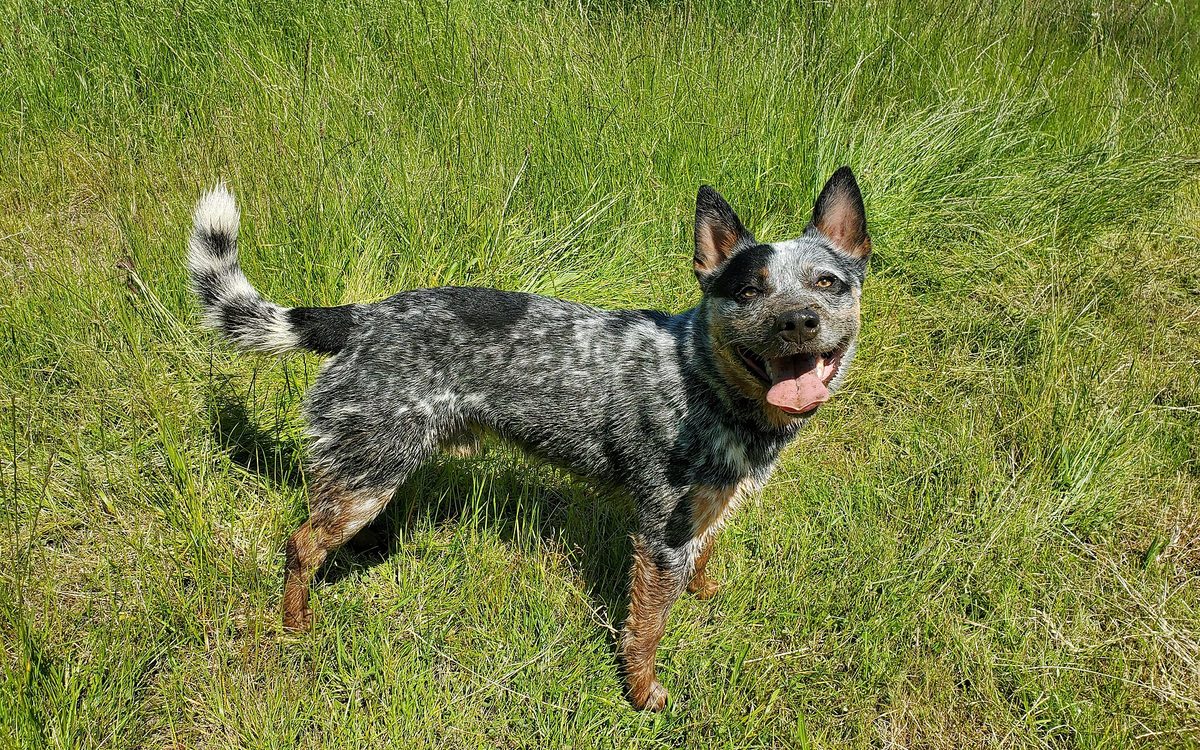
Dogs do see colour, just fewer colours than people do. Their world is mostly blues, yellows and soft in-between shades, which is why a red ball on green grass can be surprisingly hard for them to pick out.
Do dogs only see in black and white?
No. The idea that dogs see only black, white and grey is a myth, and it has stuck around for a very long time. Behavioural and eye studies show that dogs can tell some colours apart.
What they have is a more limited palette. Their vision is closer to what a person with red-green colour blindness experiences than to a black-and-white film.
Why do dogs see fewer colours than people?
The reason is inside the eye. The retina contains cells called cones, which sense colour. Most people have three types of cones, which is called trichromatic vision. Dogs have two types, which is called dichromatic vision.
One of a dog's cone types responds best to blue-violet light. The other responds best to yellow-green light. With only those two, a dog can compare blues and yellows very well, but it has much less to work with when it comes to the rest of the spectrum.
What colours can dogs see best?
Blues and yellows are the colours dogs tell apart most easily. A blue toy stands out clearly, and so does something yellow.
Reds, oranges and greens are the difficult group. They are hard for a dog to separate from one another, and they tend to look like yellowish, brownish or greyish shades. Here is a rough way to picture it:
- Blue and violet: seen clearly, as shades of blue.
- Yellow: seen clearly.
- Green, orange and red: muted and similar to each other, often yellowish, brownish or grey.
This is only an approximation, because nobody can know exactly what a dog experiences. But it matches what colour-discrimination tests and veterinary eye specialists describe.
Why can't my dog find the red ball on the grass?
To you, a red ball on a lawn is an obvious contrast. To your dog, the ball and the grass may look like two similar dull shades. The colour alone gives them little to go on.
That does not mean your dog cannot find it. Dogs often locate thrown toys using smell and movement as well as sight. A rolling or bouncing ball is easy for a dog to notice, and the nose does the rest once the dog is close.
So if your dog seems to search around for a toy that is lying still in the grass, it is not being careless or stubborn. It may simply be that the toy blends into the background.
Brightness matters as well as colour. Dogs use how light or dark an object is, not only its hue, to spot things. A toy that is much lighter or much darker than the ground is easier to see, whatever colour it is. This is why a pale toy on dark soil, or a dark toy on pale sand, tends to be easier to find than one that matches its surroundings in brightness.
What else is different about how dogs see?
Dogs give up some colour in exchange for other strengths. Their eyes have more rod cells than ours. Rods work well in dim light and are good at picking up movement. This is part of why dogs cope better than people at dusk, and why they notice small movements quickly.
The trade-off is detail. Dogs see less fine detail than people with normal vision, so the world can look a little blurrier to them, especially at a distance. Something that looks sharp and clear to you may look softer to your dog.
Put together, a dog's vision is built for spotting movement and getting around in low light rather than admiring a rainbow. Smell does a great deal of the remaining work, which is why dogs lean on their noses so heavily.
How can I choose toys my dog can see better?
A few simple choices can make play easier, especially outdoors:
- Pick blue or yellow toys. Blue is usually the best choice for a garden, because it stands out against green grass.
- Skip red and orange on grass. They are popular colours, but they can fade into the lawn from a dog's point of view.
- Think about contrast. Choose a toy that is clearly lighter or darker than the ground where you play.
- Add movement. Rolling, bouncing or tossing a toy helps your dog notice it.
- Let the nose help. Give your dog time to search. Sniffing is a natural and enjoyable part of the game.
If you are ever worried about your dog's eyesight, look out for signs such as bumping into things, hesitating in familiar places, or eyes that look cloudy or red. Do not try to work out the cause yourself. Book a visit with your vet, who can check your dog's eyes properly.
Otherwise, there is no need to worry about colour. Dogs live happily in their blue-and-yellow world, and the colour of a toy matters far less to them than how it smells, moves and feels to play with.